

Business Type: Beverage manufacturer
Main users: Hundreds of employees
Function: Room reservation, visitor and equipment management system



Smart Office, Building the Future.
A famous beverage manufacturer in Hong Kong promotes the digital transformation of its office.
Business Type: Beverage manufacturer
Main users: Hundreds of employees
Function: Room reservation, visitor and equipment management system
of new technology to successfully improve an agency’s ability to engage audiences and fulfill its objective.
Business Type: Government agencies
Main users: Dozens of people
Function: Room reservation
Case Study:
For government agencies, digital transformation or modernization refers to the use of new technology to successfully improve an agency’s ability to engage audiences and fulfill its objective.
The client is one of the most important government agencies in Hong Kong. The client currently consists of two buildings to provide office space for the key personnel of the agency. In order to enhance the efficiency of the use of office resources, the client adopted the room reservation system provided by Bookings ONE intelligent office platform, together with Crestron’s room reservation panel TSS-1070 and sensors, in order to provide a suitable smart office environment for each key personnel.
Through Bookings ONE’s reservation system, users can reserve
meeting rooms and press rooms in different buildings and floors on their schedules to reserve their daily work space. They can also make real-time room reservations on the Crestron room reservation panel at the entrance of each room and determine if the room is occupied or not via the light showing on the panel .
Bookings ONE also provide the ability to the administrators to set various rules and limits on resource usage, and encourage users to make the best use of their rooms. As a result, their limited office resources can be allocated efficiently to all users.
To find out more features and details of Bookings ONE, contact us:
Enquiry Hotline/Whatsapp: (+852) 5538 3410
Email: hello@ones.software
Website: https://ones.software/
How to perform digital transformation for a Large-scale Cultural District?
Business Type: Arts and Culture
Main users: Thousands of employees and millions of visitors per year
Features: Visitor access system
Average users may be confused by the concept of open source, normally you have to pay for softwares on the market, no matter whether it is a game, a word processor, or an operating system, in the form of the traditional one-off charge or the popular Software as a Service (SaaS) subscription pricing nowadays. The software does not give you direct access to the source code, and all source code is encrypted before it is released to the market so that no one can copy it easily. Some companies even resell source code patents from other companies as a way to make money.
However, open source software is the opposite of traditional software: it allows others to use the source code of the software to create their own software for other purposes in a specific software agreement. Under the BSD License (as defined in the BSD License), some rights are reserved for others to learn, modify, and transfer to anyone regardless of your purpose. The software is distributed, often openly and collaboratively developed and improved in the interactive communities across the web. The representatives of these are Mozilla Firefox and Android.
Many large business organizations prohibit their employees from using open source software because the security level may not meet the requirements of the organizations, and a large number of security tests have to be conducted beforehand. However, the federal government of Germany, governments of Brazilian and various universities are actively encouraging their employees to use open source software. In addition to the lower cost of software, they also want to reduce reliance on software from foreign companies.
Open-source software is more and more recognized by large business organizations and is even considered as a golden egg. In July 2019, IBM paid US$190 per share, or US$34 billion, to acquire a well-known open-source operating system developer, IBM Corporation Red Hat to co-develop a next-generation hybrid cloud platform. In 2018, Microsoft spent $7.5 billion to acquire colocation GitHub, a service platform for a wide range of open source software sources, shaken off its perennial image of being relatively closed, and has emphasized the importance of the GitHub will “reinforce a free, open, and innovative approach to developers,” in the spirit of developers first, with Microsoft’s Each maintains its own independent mode of operation. Businesses now see open source as a tremendous resource that would revitalize the businesses itself.
“Joining forces with IBM gives Red Hat the opportunity to bring more open source innovation to an even broader range of organizations and will enable us to scale to meet the need for hybrid cloud solutions that deliver true choice and agility.” JIM WHITEHURST, PRESIDENT AND CEO, RED HAT
The concept of open source is no longer limited to the realm of software, RISC-V is an example of “open source hardware”. Likewise, commercial chip vendors such as ARM and MIPS spend a lot of money on CPU design due to their expertise in different areas. Given the huge resources invested, these suppliers have to charge high licensing fees for the use of their patents and copyrights in order to survive. They also sign confidentiality agreements to protect their suppliers’ rights before using their advantageous design files and command sets. However, these traditional protection techniques stifle the development of the public, low-cost, free and open source software compilers and operating systems. RISC-V was born from the premise of pioneering “open source hardware”.
RISC-V is a simple, completely open source architecture that allows anyone to design, manufacture, and market RISC-V chips and software for the benefit of the public. The RISC-V Foundation is supported by many technology giants without paying royalties to companies. Google, Qualcomm, Microsoft, Huawei, Alibaba, Fidelity and others have joined the RISC-V Foundation. With strong funding from the Indian Government, RISC-V has become the national instruction set of India. Microsoft has also taken the lead as the OpenPOWER Foundation to promote its RISC-V program. This year, the company announced that it has merged into the Linux Foundation and is developing its open source Power chip. In addition, the company has developed the Instruction Set Architecture (ISA) to enable PowerChip without the need to pay royalty.
Currently, large commercial chip suppliers such as ARM and Intel dominate the processor market for many tablet computers and smart phones. With IoT on the horizon, the demand for chips is increasing. The emergence of “open-source hardware” such as RISC-V and power chips is poised to bring competition to the chip industry, making the overall chip market more competitive. The economic benefits of lower development costs are enormous, and lower development costs help to drive the development of new technologies such as artificial intelligence, supercomputers, data warehousing and data warehousing, analytics and IoT technology development.
The “open source hardware” also addresses some current geopolitical issues. As the technology war between two major political parties, the U.S. and China, is intensifying, many global software and hardware companies suffer under the conflict of power. The ZTE and Huawei incidents in 2018 forced China to look for a new way out for its hardware.
In the words of the RISC-V Foundation’s China advisory board chairman, Fang Zhixi:
“A typical example is Loongson. A chip is still a commodity, no matter how high the performance is, if no one uses it, it has no value, so there must be a corresponding ecosystem to give full play to its value. There are many Chinese companies making x86, Arm, and IBM Power chips, and the second way is to follow others. In some specific areas, there are things that can be done with these instruction set architectures, but they are subject to the ISA’s intellectual property (IP) rights. The lack of intellectual property restrictions on “open source hardware” such as RISC-V makes it difficult to succeed.”
The lack of intellectual property restrictions on “open source hardware” such as RISC-V makes it difficult for China, India, and other countries that do not have the ability to control RISC-V to succeed. Countries that manufacture their own chips are able to develop their own chips on a common basis, reducing their dependence on foreign technology. This allows the development of technology in different places to be less adversely affected by geopolitical changes and conflicts.
The introduction of the concept of “open source” can also improve the corporate culture which is technologically closed, and enable users to make use of their open source technology to develop their own chips. Compare the functional part with other products, this enables different technology products to be publicly verified, increasing their transparency and market competitiveness.
The open source concept can bring us a more free, open and innovative technology development base, improving the technology R&D environment, and at the same time adding new impetus to the existing technology industry. It is foreseeable in the future that enterprises around the world will be able to break through the past business limitations, and the development of technology as a whole may benefit from this.
Website: https://ones.software/
Email: hello@ones.software
Tel: (+852) 5538 3410
比起房間預約,客戶首先接觸的就是訪客系統,而如何給予用戶最好的第一印象,至為重要。
上一章我們提到,智能辦公室其中一個必要元素是會議室預約系統,這次我們將提及另一個必要元素--訪客管理系統。首先,我們重溫一下智能辦公室的定義:
『智能辦公室是一個以尖端的互聯網技術為基礎,透過收集數據,對企業中至為關鍵的操作系統和服務進行中央控制, 其一系列不同的協同工作得以創造一個更先進、以人為本的工作場所。而智能辦公室可以增強用戶體驗,有助於提高生產力,亦能吸引和留住企業人才,也可以更靈活、更有效地利用辦公室空間,降低企業成本,提升企業本身的品牌價值。』
Continue reading “智能辦公室的基本元素(II):訪客管理系統”

All enterprises, big and small, wish to turn themselves into a smart office to fully utilize their resources. But, what is a smart office?
Smart office, based on leading-edge Internet technology that centralizes the control of crucial operations and services of an enterprise through data collection, creates a more advanced and people-oriented workplace under the collaborative workings of Internet technology.
While the enhanced user experience in smart office settings facilitates staff productivity and helps to attract and retain talents, businesses also enjoy savings in cost and a boost in brand values through a more flexible and efficient deployment of existing office space.
The application of electronic devices and tools, such as iBeacon, sensors, and mobile phone applications are typical in smart office settings, saving staff from routine office chores and increasing their focus on business activities. One of the key elements of a smart office is the adoption of the room booking system.
The room booking system allows users to identify the best suitable room for meetings and complete the booking in a few clicks independently of time and location with mobile apps supporting various platforms. Fast and easy room booking is available at your fingertips.
By providing a comprehensive range of room information and centralizing the scheduling of rooms on a common platform, the room booking system provides the know-how for better resource utilization for the management.
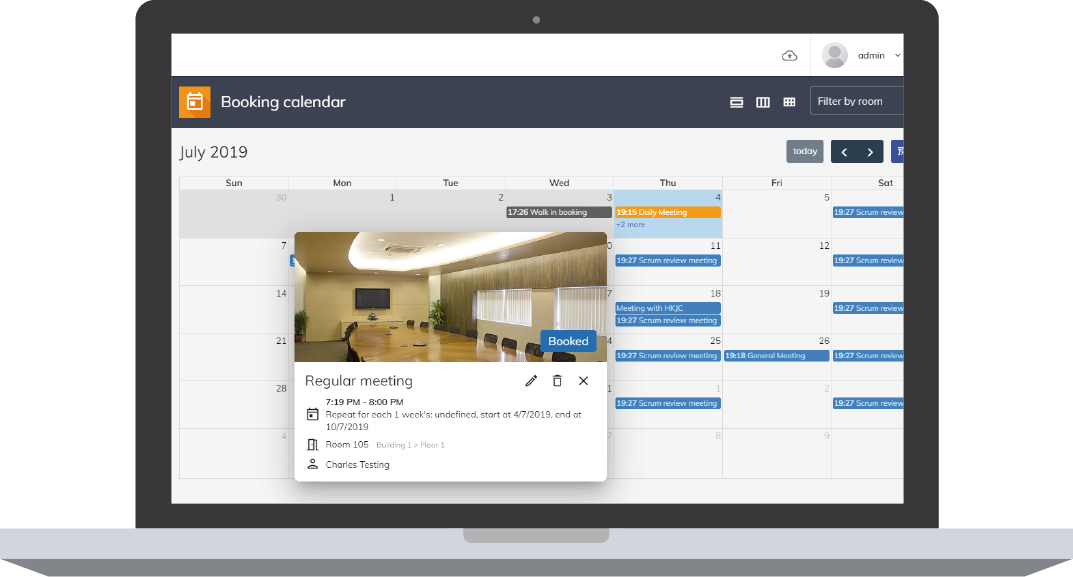
The basics of room booking system rooted in the booking schedule. Bookings ONE strives to create a concise and clear schedule presentation and support all operations in computers interfaces and mobile devices.
You can browse the latest schedule and manage room booking, wherever you happen to be, just a few clicks on your mobile phone.
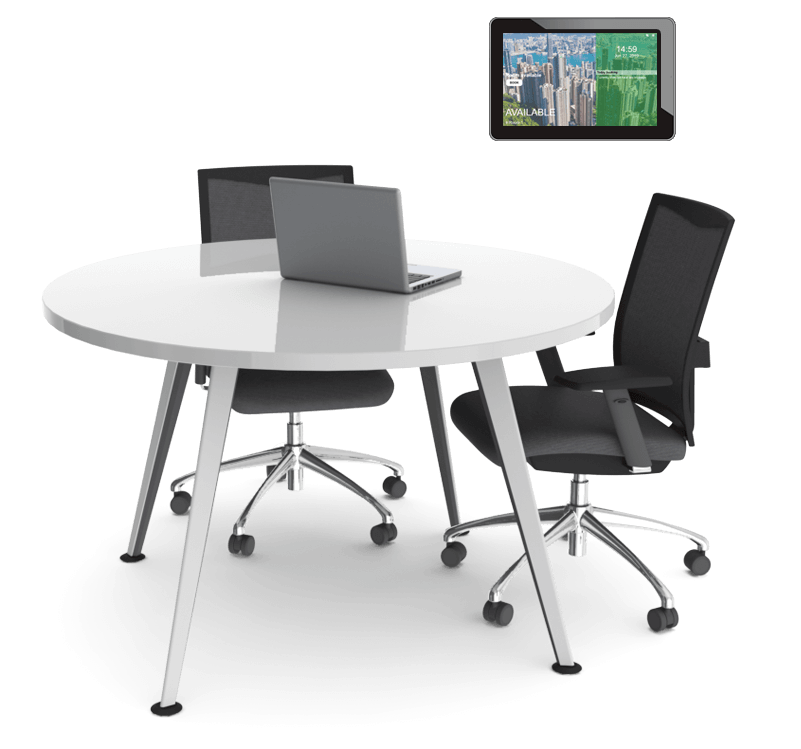
Display mounted outside the room shows clearly the current booking status and operating condition of the room, creating an energizing image for the company while gently reminding staff and guests of the meeting location.
The design of room display under Bookings ONE seamlessly supports tablet devices under various operation platforms, including iOS, Android and Windows. Users can make an instant booking simply by tapping on the display mounted outside the room.
Bookings ONE also supports display devices with LED indicators, which enables users to identify the status of rooms easily from a distance through color variation. The indicators included three colors: the green represents the room is available, orange represents reserved and red means currently being occupied.
When you have a sudden need for a meeting room, and are uncertain about which rooms have been booked already, the LED indicators will definitely brighten up your mind and show you the way.
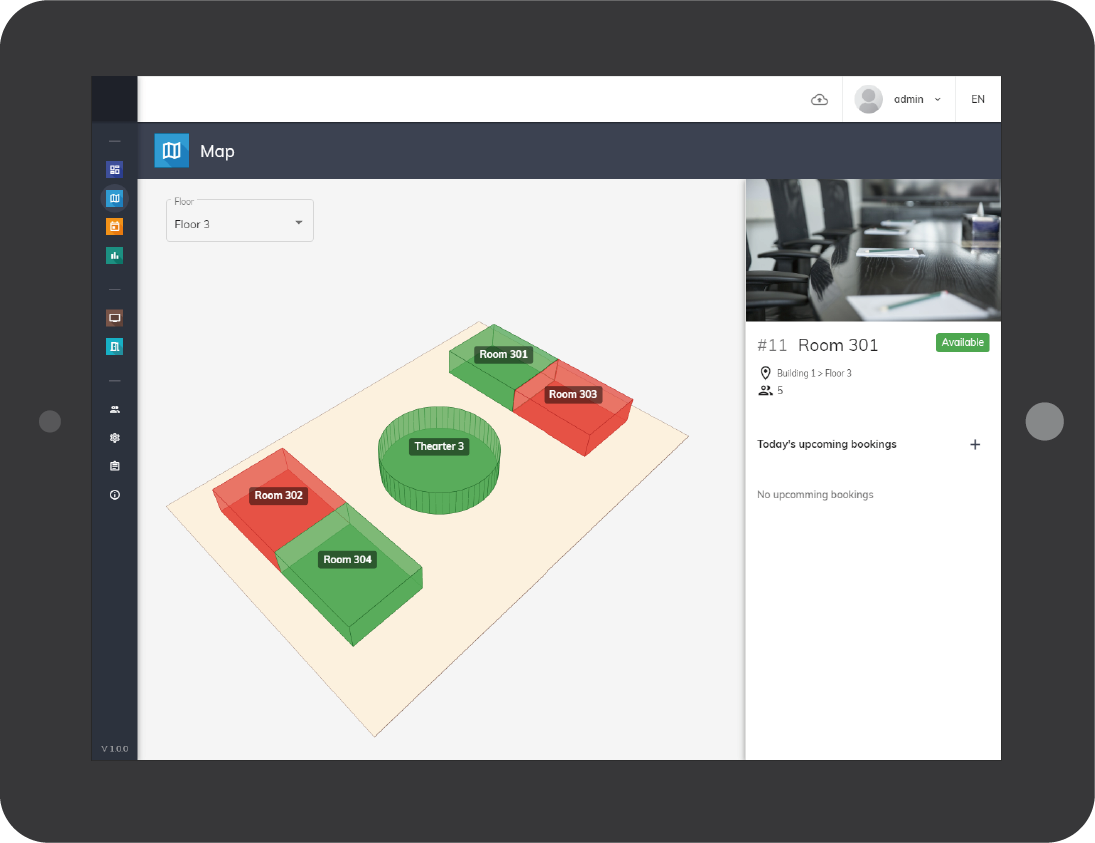
A well-designed interface of the booking system is essential in supporting the management to devise strategies for resources allocation. Considering that there are 50 conference rooms in a company, for most of the booking systems, the data of booking status and appointment details of the 50 rooms would be tabulated plainly on a list, providing you a comprehensive set of data.
However, extracting useful information from such a large volume of data could be both time-and-energy consuming, managers may be tricked into overlooking important information and even resulting in mismatch of resources.
That’s why Bookings ONE has additionally placed emphasis on the 3D floor plan of each floor, besides providing standard lists of data-set. We visualize all booking status on a map, you will be informed of dozens room status at a glance. Easily readable and understandable.
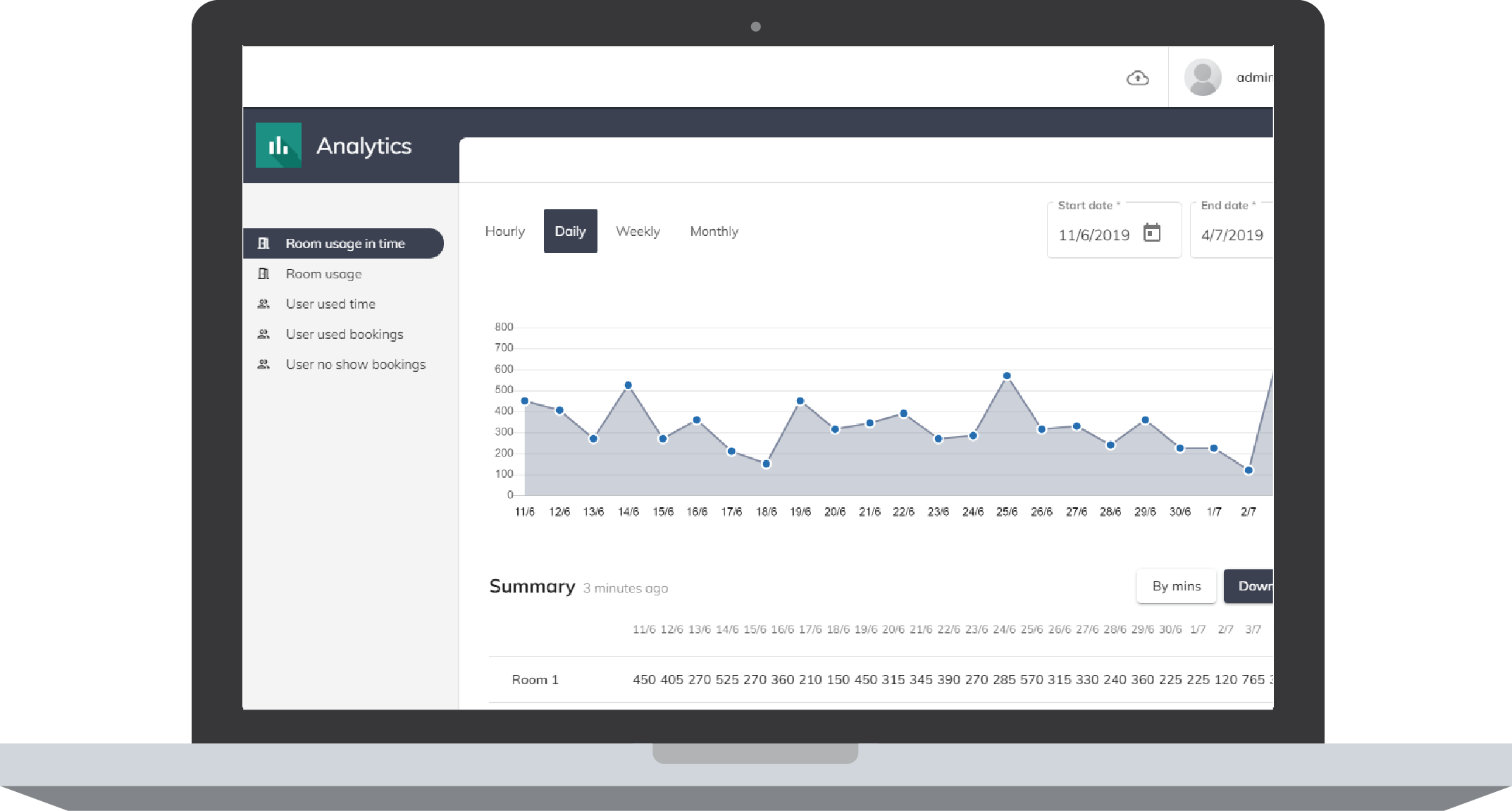
Another effective tool for the management to optimize resources utilization is real time data analytics. Cost of conference rooms, directly or indirectly, is expensive considering the spiraling rental cost.
In order for the management to utilize and allocate company resources efficiently, conference rooms in particular, Bookings ONE generates graphical analytics and reports that could be exported to Excel file to facilitate readability and better understanding on information such as utilization rate of rooms, the length of booking and absence rate to use a room of respective users at different times.

Using calendars of Google and Outlook to coordinate booking schedule has often been the norm in companies before the presence of room booking system. We understand that it takes time for users to adapt new booking technology and be familiar with a new interface before enjoying the benefits Bookings ONE offers.
Therefore, we devoted time in developing seamless integration with calendar systems including Google Calendar, Exchange server and Office 365 that are commonly used in the business sector, and succeeded in synchronizing bookings made through a third-party system into Bookings ONE simultaneously.
New users of Bookings ONE could continue to book through the calendars they are used to, while enjoying the features and benefits offered by Bookings ONE during the transitional period.
We strive to offer the best user experience to our business partners while fulfilling the needs of both management and staff. Bookings ONE can upgrade corporate image and improve staff efficiency.
To find out more features and details of Bookings ONE, contact us at:
Enquiry Hotline/Whatsapp: (+852) 5538 3410
Email: hello@ones.software
Website: https://ones.software/
現在的企業不論規模大小,都希望將公司變為智能辦公室,以使公司的各種資源得以充分利用。 那麼怎樣才算是一個智能辦公室?
智能辦公室是一個以尖端的互聯網技術為基礎,透過收集數據,對企業中至為關鍵的操作系統和服務進行中央控制, 其一系列不同的協同工作得以創造一個更先進、以人為本的工作場所。而智能辦公室可以增強用戶體驗,有助於提高生產力,亦能吸引和留住企業人才,也可以更靈活、更有效地利用辦公室空間,降低企業成本,提升企業本身的品牌價值。
智能辦公室主要透過利用 iBeacon、感測器和電話應用程式等等電子工具,幫助員工處理公務上的瑣事,從而使他們能夠專注較重要的事務,而其中一個智能辦公室不可或缺的基本元素,就是會議室預約系統。會議室預約系統主要讓使用者能夠快捷地找出適合的會議室,並完成會議室的預訂,配合各平台上的應用程式,使員工可以在不同時間、地點,都能夠輕鬆安排會議。會議室預約系統亦能夠提供會議室的各種資訊,以作企業管理之用,並將會議室排程集中於同一個平台,使企業管理者能夠對公司資源運籌帷幄。
我司藉著推出的 Bookings ONE,希望提供一個嶄新的會議室預約系統,可以使企業能夠充分善用辦公室資源。 Bookings ONE 主要有以下功能:
會議室預約系統的根本,莫過於預約時間表。 我司製作Bookings ONE時, 力求預約時間表達致清楚簡潔的要求,並且支援所有電腦界面和手機端的操作。無論你在哪裡,只要打開手機,都能輕易地管理到所有房間的狀態。
房間電子標牌安裝在房間門前,可以清楚地顯示房間現在的使用狀態,確保使用者不會不小心去錯別的房間之餘,也能透過展示適合的圖像,以提升公司形象。
Bookings ONE的房間電子標牌,支援 iOS, Android,Windows 這些不同作業系統的平板設備,使用者可以在輕鬆地走到房間門前,就能進行即時的房間預約,快捷方便。 我司同時支援附有指示燈的顯示設備,就算在遠處,使用者也能清楚地看見指示燈的顏色,從而得知哪些房間已被預約。指示燈的顏色主要分為三種:綠色代表可供使用,橙色代表已預約,而紅色代表正在使用。當你突然需要展開會議,又擔心不知道會不會有其他人已預約某些房間的話,指示燈絕對是你公司裏的明燈。
如何能夠令管理者對公司資源運籌帷幄,預約系統的界面設計至為重要。假設在公司有50間會議室,一般坊間的預約系統就會把這50間會議室的狀態、預約資料等,以列表的形式平白地列出。這樣的列表雖然能夠提供所有資訊,但是表現方式並不直觀, 管理者往往要從頭到尾消化大量數據,容易使管理者過於疲勞,甚或看漏一些資訊,導致資源錯配等問題。
有見及此,Bookings ONE在傳統的列表顯示外,銳意加入能夠顯示各個樓層的3D平面圖功能,用最容易理解的方法去顯示所有房間的狀態,即使一個樓層數十間房間也能一目了然, 管理者再也無需花時間去看每一個房間的預約狀態。
另一個有效幫助企業管理者去利用公司資源的方法,就是實時的數據分析。現在租金飛騰,會議室的空間附帶著很多直接和間接的成本。通過我司的系統,管理者能以圖像化的分析,理解各個時段的會議室使用率、各人的使用時間、 因失約導致房間空置的次數等等,亦能匯出成為 Excel 形式的分析報告,從而讓企業更了解公司會議室有否被充分利用,從而更有效運用、分配公司的資源。
Google和Outlook的日曆系統相當深入民心,在未有會議室預約系統的公司裡面,主要都是用這些日曆系統去作出管理。我司理解,縱使 Bookings ONE 能夠提供更好的用戶體驗給各個用家,但要所有使用者短期內放棄使用多年的日曆系統,改用 Bookings ONE 的界面的話,很多用戶一下子難以適應。
為此, 我司花了不少開發時間,成功無痕連接上 Google Calendar / Exchange server / Office 365 這些主要在公司會使用的日曆系統,能夠即時將第三方系統的預約,同步到 Bookings ONE 裡頭。這樣新用戶在未熟悉我們的界面前,可以繼續使用他們本來一直使用的日曆系統作出預約,也能夠同時間使用 Bookings ONE 裡頭的各種功能。
除了以上所提到的功能外,Bookings ONE 還有更多的功能與細節,務求提供最好的用戶體驗給企業,不論是管理層還是員工的需求都能一一滿足,從而提升公司形象和員工整體工作效率。
欲免向隅,馬上聯繫我們: hello@ones.software / (+852) 5538 3410, 亦可到 Bookings ONE 官網了解更多 :https://ones.software/hk/bookings-one/ 。
聯絡我們:
主頁: https://ones.software/hk/
電郵地址: hello@ones.software
電話號碼: (+852) 5538 3410
Contact us:
Homepage: https://ones.software/
Email address: hello@ones.software
Phone number: (+852) 5538 3410
如果有接觸過網頁開發的讀者,或者會聽過很多不同的專有名詞,其中不少得Front-end (前端) 和 Back-end (後端)這兩個字詞。有一些網站可能只需要設計師和前端開發者,有些則需要後端開發者和測試人員等等,那究竟前端和後端如何分辨?首先,讓我們搞清楚前端開發是什麼一回事。
Continue reading “甚麼是前端開發?”可擴展性就是說當軟件的用量增加時,可以通過系統架構的調整去應付增加的用量。
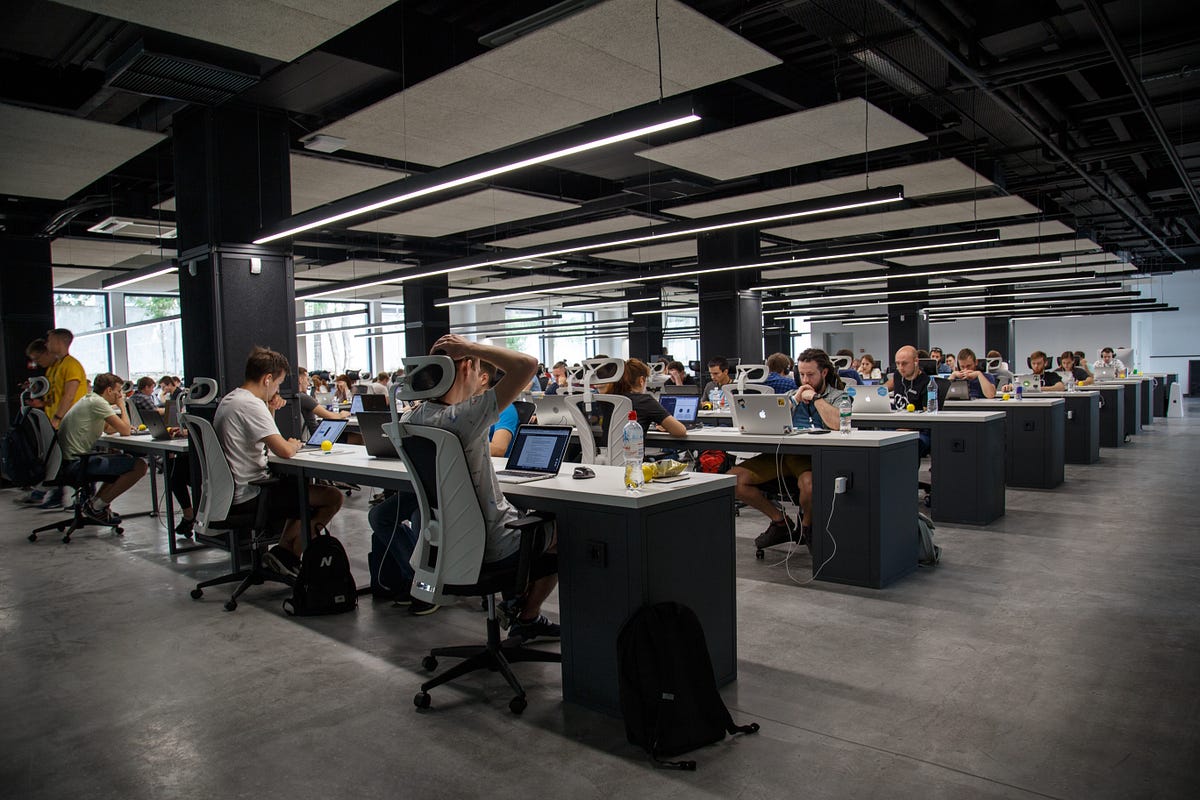
這篇文章繼續上一篇有關企業用軟件訂閲服務開發的探討,而這次談到可擴展性 (Scalability)。可擴展性就是當軟件服務的用量增加時,可以通過系統架構的調整去應付增加的用量。而對於企業軟件來說,用量增加也代表客戶增加,這裡會一同探討軟件服務會面對不同規模的客戶。
Continue reading “SaaS的可擴展性:如何使你的軟件不論初創企業還是跨國公司都能支援得到?”談談如何去實際架構出一個多用戶模式的服務器架構,並能實現客戶獨立、穩健、容易維護的特點。
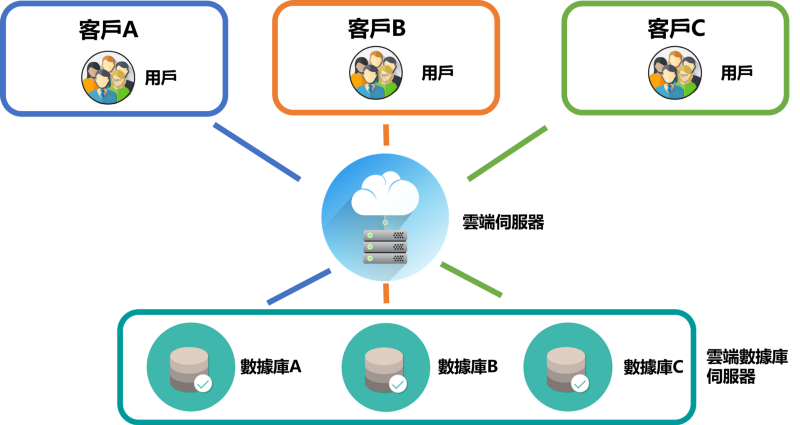
我們於上一篇提過關於多租戶模式 (Multi tenancy) 的各種好處,今日我們就來談談如何去實際架構出一個多用戶模式的服務器架構,並能實現客戶獨立、穩健、容易維護的特點。
Continue reading “SaaS的多租戶模式(Multi-tenancy)實踐:.NET Core + Entity Framework Core”